
informational 5 min read
Westminster Abbey Lady Chapel: Henry VII's Tudor Chapel
Updated October 27, 2026
Short answer: the Lady Chapel is the Tudor chapel at the far east end of Westminster Abbey. Henry VII began it in 1503, it was finished in 1516, and it holds a fan-vaulted roof, the banners of the Order of the Bath, the tombs of fifteen kings and queens, and the RAF Chapel. It is part of the normal visitor route, so any Abbey sightseeing ticket covers it.
Who built the Lady Chapel at Westminster Abbey?
Henry VII built it. The Abbey says he began the chapel in 1503, and it was not completed until 1516, nearly six years after his death. The architects are thought to have been Robert Janyns and William Vertue.
The Abbey calls it the Henry VII Lady Chapel. Henry built it as a burial place for his Tudor family, though his son Henry VIII chose to be buried elsewhere. On the Abbey’s suggested route you reach it after the High Altar and the royal tombs around the Shrine of St Edward the Confessor, and before Poets’ Corner.
What is special about the Lady Chapel ceiling?
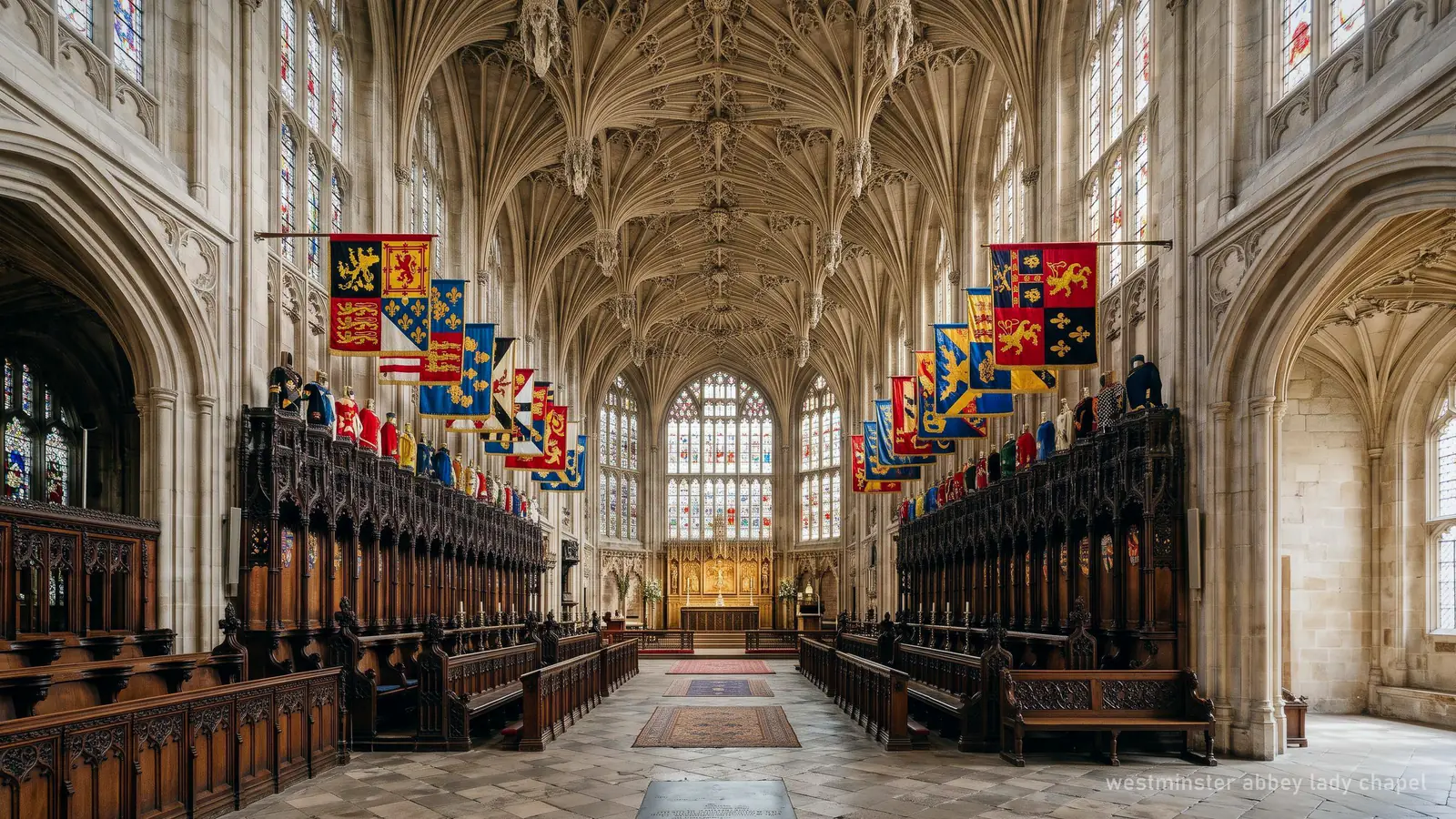
The ceiling is a fan vault with carved stone pendants hanging down from it. Look straight up as you enter. The ribs spread out like fans and the pendants seem to hang in the air, which is why most visitors stop at the door.
Around the walls, 95 statues of saints still survive. Below them are the wooden stalls. Under the hinged seats are carved misericords, small ledges that let monks and choir members lean while standing through long services. Lift your eyes from the stalls to the vault and you see five centuries of carving in one view.
Why are there banners in the Lady Chapel?
The banners belong to the Knights of the Order of the Bath. The Abbey says the chapel has hosted their installations since 1725. The banners of living knights hang above the stalls, and brass plates with the arms of current and former knights are fixed to the stalls themselves.
That is why the chapel is so colourful compared with the grey stone elsewhere. The banners change as knights die and new ones are installed.
Who is buried in the Lady Chapel?
Fifteen kings and queens are buried in the Lady Chapel, the Abbey says. The best known are Elizabeth I, Mary I and Mary, Queen of Scots, whose tombs sit in the side aisles.
- Henry VII and Elizabeth of York lie in a vault beneath their own tomb, together with James I.
- Edward VI, Henry VII’s grandson.
- Charles II, William III and Mary II, and Queen Anne.
- George II and Queen Caroline, in the Hanoverian vault under the central aisle. George II, who died in 1760, was the last monarch buried in the Abbey.
- Anne of Denmark, queen of James I.
- Bones believed to be those of Edward V and Richard, Duke of York, the “Princes in the Tower”, buried here on the order of Charles II.
The tombs of Elizabeth I, Mary I and Mary, Queen of Scots are up steps: 12, then 3 more. For the full list of royal graves, see our guide to the royal tombs at Westminster Abbey.
What is the RAF Chapel and the Battle of Britain window?
The RAF Chapel is at the very east end of the Lady Chapel. It honours the men of the Royal Air Force who died in the Battle of Britain, between 10 July and 31 October 1940. King George VI unveiled it on 10 July 1947.
Its window, by Hugh Easton, shows the badges of the fighter squadrons that took part in the battle. A Roll of Honour lists 1,497 pilots and aircrew killed or mortally wounded. Look for a small hole in the stonework covered with glass: a bomb made it in 1940, and the Abbey kept it as a reminder. Lord Trenchard and Lord Dowding are both buried in this chapel.
The glass around it is mostly modern. The original Tudor glass was lost under Cromwell and in Second World War bomb blasts. The main east window is by Alan Younger (2000), and two windows beside it by Hughie O’Donoghue were added in 2013.
How to see the Lady Chapel
The Lady Chapel is included in the standard Abbey ticket, £32 for adults on the Abbey’s own site (about $43). The multimedia guide covers it. If you want someone to explain the tombs and the banners as you stand there, book a guided tour of Westminster Abbey, from $100, with a licensed guide and the priority group entrance. The Abbey’s own verger-led tours (entry price plus £10, booked on arrival) list the Lady Chapel among their stops.
Plan at least 20 minutes here. The chapel can feel crowded because it is narrower than the nave, so a weekday morning just after the 9:30am opening is the calmest time. See what else is inside the Abbey to plan the rest of the visit.
Check prices & dates
Book your tickets in advance: popular time slots sell out.
Book Westminster Abbey Tickets
From$43per person
Check availability- Free cancellation up to 24h
- Reserve now, pay later
- Multimedia guide or live guide included
Frequently asked questions
Is the Lady Chapel included in a Westminster Abbey ticket?
Yes. The Lady Chapel is on the Abbey's standard visitor route, so the £32 adult sightseeing ticket (about $43) covers it. There is no extra charge for the chapel itself.
Is Elizabeth I buried in the Lady Chapel?
Yes. The Abbey lists Elizabeth I among the fifteen kings and queens buried in the Henry VII Lady Chapel, together with Mary I and Mary, Queen of Scots.
Is the Lady Chapel step-free?
No. The Abbey says the Lady Chapel and the tombs of Elizabeth I, Mary I and Mary, Queen of Scots are reached by steps (12 steps plus 3). Ask an Abbey Marshal on the day about the best route.
Can I take photos in the Lady Chapel?
Personal photos without flash are allowed in most of the Abbey, including the Lady Chapel. Photography stops during services, and it is never allowed in the Shrine of St Edward the Confessor, St Faith's Chapel or the Galleries.
Sources